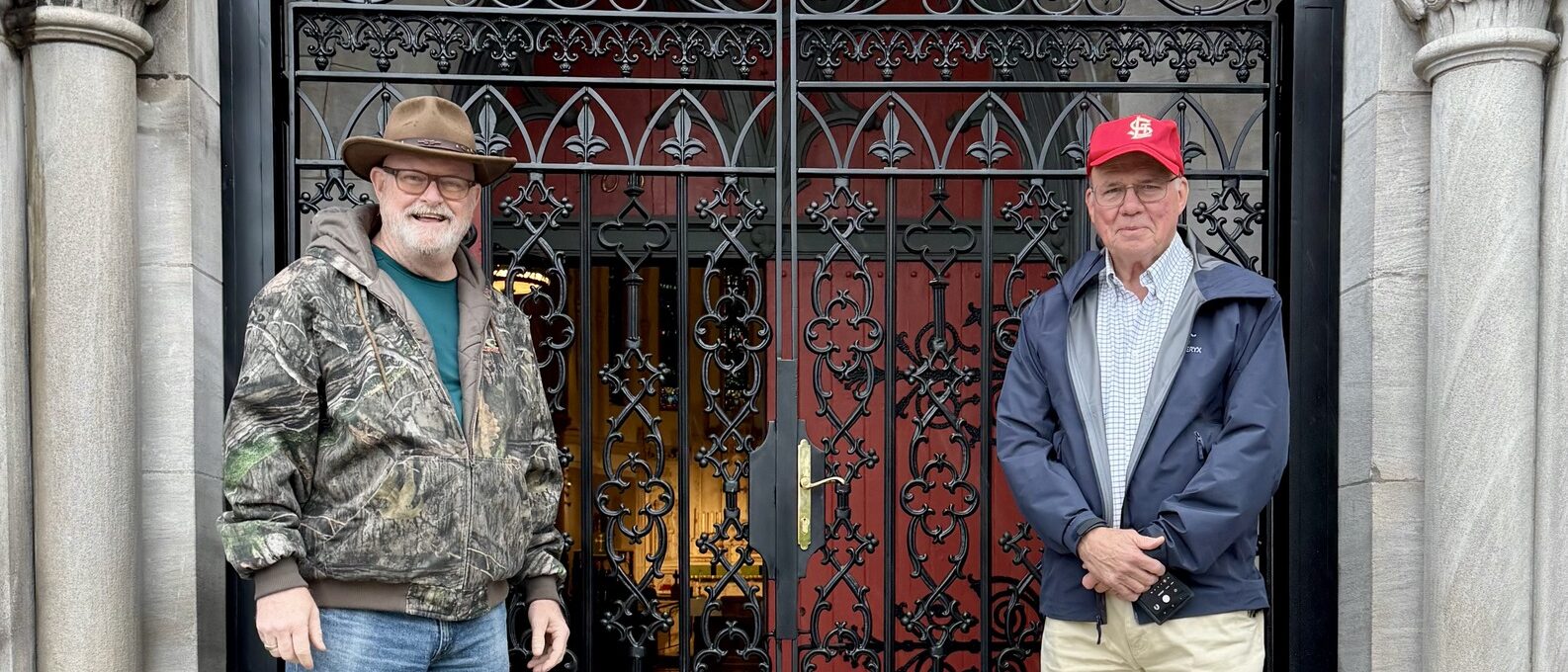
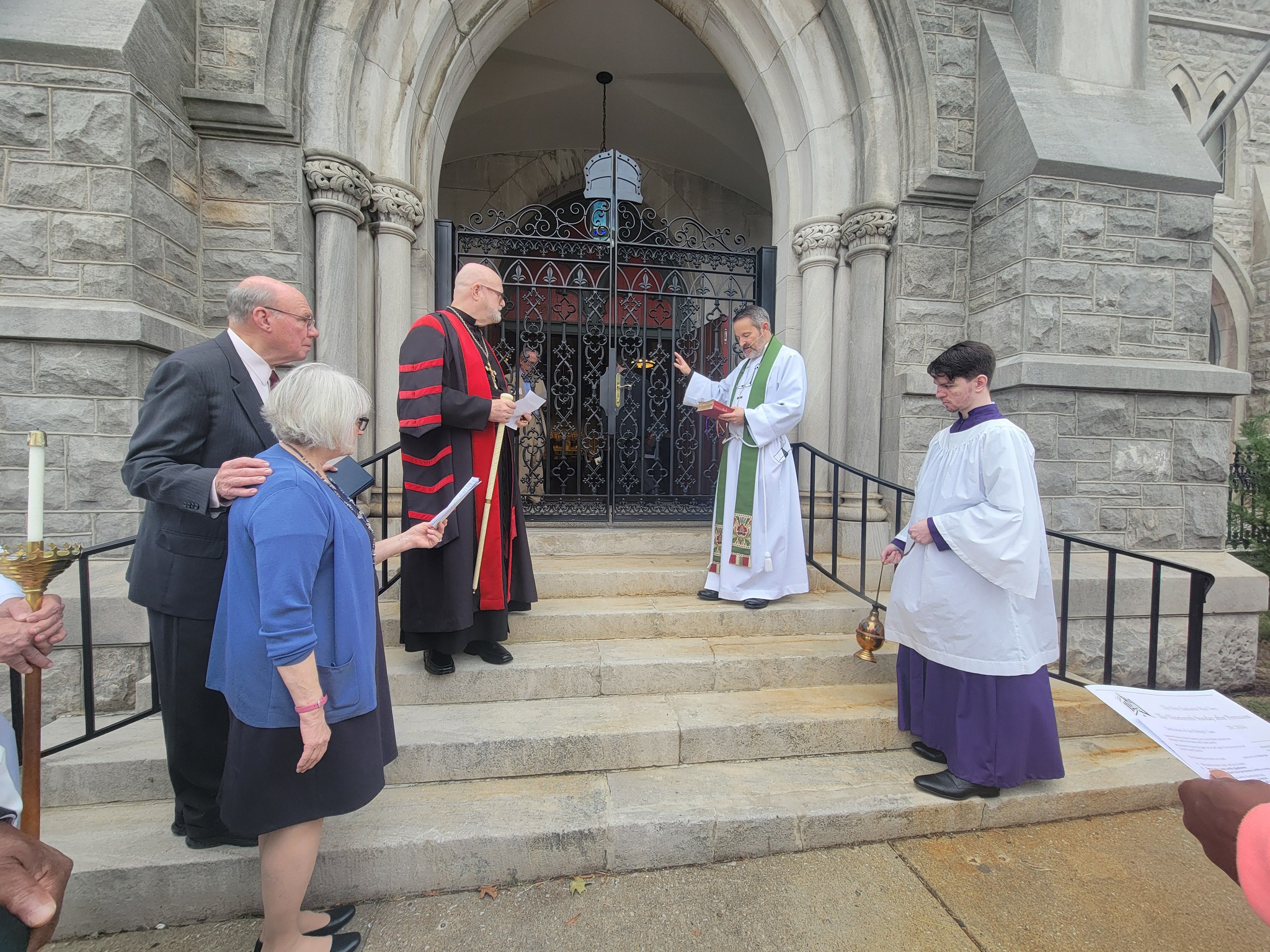
In Fall 2025, a new plaque was installed beside the Bishops’ Gate at St. Mary’s Cathedral, quietly anchoring centuries of episcopal leadership and lived faith in West Tennessee.
The plaque does not call attention to itself at first glance. But for Andy Pouncey, that restraint is precisely the point.
“It’s not about when it was built,” Pouncey said. “It’s about what the gate is for.”
Why a Gate, and Why a Plaque
The project began with a practical concern. When Pouncey ‘s tenure as cathedral administrator at St. Mary’s began in 2022, there were no gates securing the cathedral’s front porch, creating challenges for hospitality and upkeep.
While St. Mary’s has long been committed to ministries of compassion, the front entrance needed clearer boundaries. Gates provided safety,but Pouncey believed they also required interpretation.
“A gate is a threshold,” he said. “It says something about who we are and how we welcome.”
That understanding led to the decision to include a plaque naming the bishops who have shaped the Diocese over time.
From “Dean’s Gate” to Bishops’ Gate
Initially, Pouncey considered calling it the “Dean’s Gate,” reflecting the cathedral’s role in diocesan life. But after conversation with leadership, including former interim dean Gary Meade, the name shifted.
“Bishops’ Gate made more sense,” Pouncey said. “A cathedral is the bishop’s church.”
The plaque traces that episcopal lineage back to the era when West Tennessee was part of the Diocese of Tennessee. The 1982 General Convention of the Episcopal Church voted to divide the Diocese of Tennessee, thus establishing the Diocese of West Tennessee. The plaque commemorates the following bishops:
The Diocese of Tennessee
James Otey (1834-1863)
Charles Quintard (1865-1898)
Thomas Gailor (1898–1935)
James Maxon (1935–1947)
Edmund Dandridge (1947–1953)
Theodore Barth (1953–1961)
John Vander Horst (1961-1977)
William Sanders (1977-1985)
The Diocese of West Tennessee
Alex Dixon (1983-1994)
James Coleman (1994-2001)
Don Johnson (2001-2019)
Phoebe Roaf (2019-present)
Designing Something That Would Last
Pouncey worked with St. Mary’s parishioner Scott Blake to design the plaque, along with diocesan staff and fabricators. Accuracy mattered. So did durability.
“Once you order it, you can’t afford to make a mistake,” he said.
The process took nearly a year. One of the most challenging elements involved incorporating the historic diocesan seal, which had never been digitized in modern formats.
Even the placement required care. The plaque was mounted to compensate for the cathedral’s subtly uneven masonry and positioned so it could be read comfortably without dominating the entrance.
“I didn’t want it to say, ‘Look at me,’ ” Pouncey said. “I wanted it off to the side.”
Early designs imagined gilded details and sculptural flourishes. But those ideas were ultimately set aside, both for financial reasons and theological ones.
“What does that speak to the people across the street?” Pouncey recalled asking. “That we have something and you don’t?”
Instead, the final design relies on proportion, texture, and contrast, especially the visual interplay between the dark metal gate and the cathedral’s red door behind it.
“The simplicity works,” Pouncey said. “And if you paint something, what does that mean? You have to paint it again.”
A Lifetime at the Threshold
For Pouncey, the Bishops’ Gate is deeply personal. His family’s connection to St. Mary’s dates back to the early 1930s. His parents were married in the chapel in 1944. He and his wife Kate were married there in 1974.
“It’s always going to be home.”
As a historian, Pouncey sees the plaque as more than a list of names. It is a reminder that the church stands at the intersection of memory and mission.
“St. Mary’s ministers to those on the fringes,” he said. “That’s what Jesus did. And that’s what this place continues to do.”
At the Bishops’ Gate, the past does not close the door. It frames the passage forward.